

Every Event Has a Soundtrack. Is Anyone Designing It?
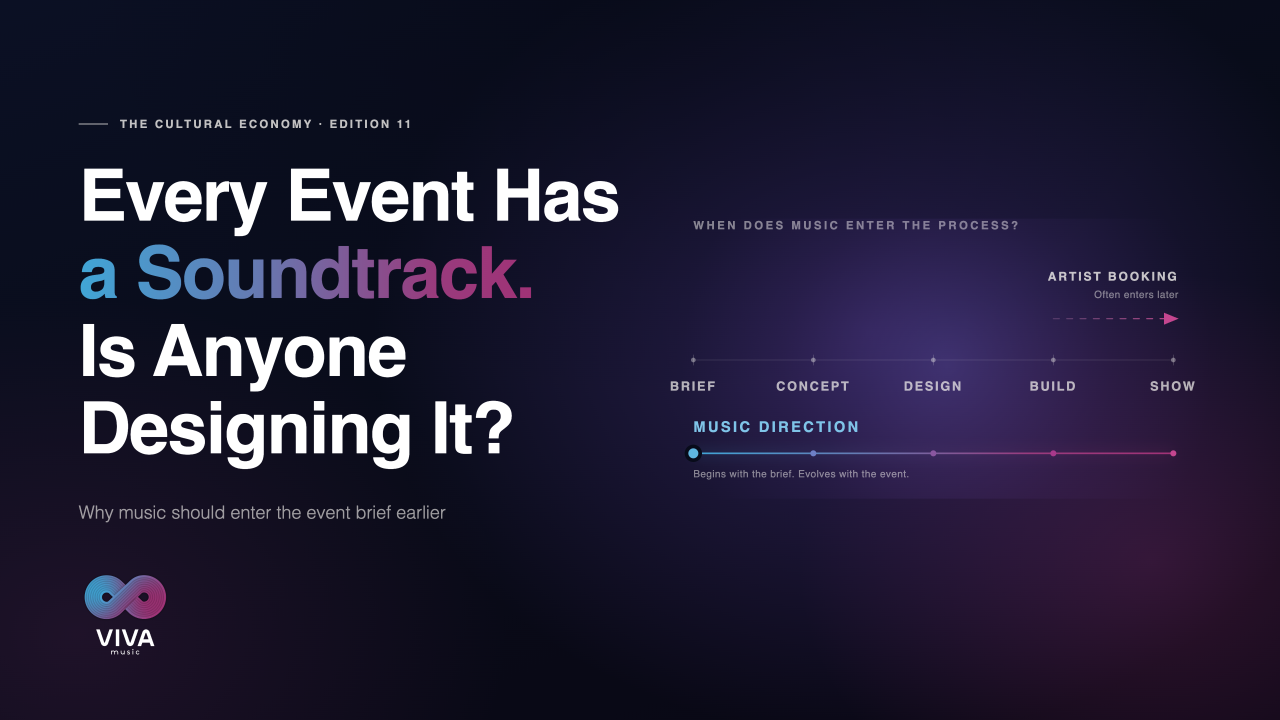
We spend enormous effort designing what people see, where they move and how an event should feel. Music deserves to enter that creative conversation much earlier.
Try imagining a film without its background score.
Put cheerful, upbeat music under an intensely emotional scene and the meaning changes. Put tension-building music under an ordinary shot of someone walking down a corridor and suddenly we are waiting for something to happen.
The images have not changed.
The music has changed our interpretation of them.
The same thing happens in live experiences.
Imagine a football team walking onto the pitch with quiet background music instead of the anthem or high-energy track designed to make a stadium rise.
Imagine a bride entering a wedding ceremony in complete silence. Now imagine exactly the same entrance with a song that means something to the couple.
Imagine a luxury product being revealed while an unrelated party playlist continues underneath it.
Or the final award of an evening being announced while the music carries exactly the same energy as it did during dinner.
Nothing is technically wrong in any of these situations.
But something is emotionally disconnected.
Because music is not simply filling silence. It is constantly helping an audience understand how to read a moment.
This is not about technical sound design. It is about the musical thinking behind an experience: what is heard, when it is heard, why it is there and what it is meant to make people in the room do or feel.
And yet, despite how sophisticated live events have become, music and entertainment can still enter the planning process surprisingly late.
The stage has been rendered. The lighting has been designed. The screens have a content plan. The guest journey has been mapped. The branding, food and production details are already taking shape.
And then someone asks:
What should we do for entertainment?
The conversation becomes:
DJ or band? Who is available? What fits the budget? Can you send a few options?
All of those are necessary questions.
But perhaps they are not the first ones.
Perhaps the first is:
What should this event sound like?
And beneath that:
What is music supposed to do here?
Music does more than entertain
We tend to notice music at events most when someone is standing on a stage performing it.
But music is shaping the experience long before the headline act appears.
It is there when people enter.
It can make an empty venue feel expectant before anything has begun.
It can make a networking reception feel elegant, energetic, intimate, youthful or painfully corporate.
It can pull attention towards a stage, build anticipation before a reveal, soften a transition or signal that dinner has ended and the celebration has begun.
It can also make 300 people trying to have conversations compete with a performer nobody is actually listening to.
That last example matters.
Because if we think of music only as entertainment, the instinct is often to add more.
Another performer.
Another activation.
Another musical moment.
But if we think of music as part of experience design, sometimes the better decision is to do less.
Silence can be designed too.
So can restraint.
The question is not simply whether the music is good.
It is whether it is doing the right job at the right moment.
Fashion has understood this for years
Fashion has been treating music as part of the creative direction for years.
Watch a major runway show and the soundtrack is rarely there simply to stop the room from being silent. It helps establish pace, tension, attitude and even how we perceive the clothes.
Change the soundtrack and, in some cases, you change the show.
A collection can suddenly feel more rebellious, romantic, futuristic or severe without changing a single garment.
That is because, at its best, fashion does not ask:
"What music should we play behind the show?"
It asks a more interesting question:
What should this world sound like?
Chanel's 2023/24 Métiers d'Art show in Manchester is a good example.
Manchester was not simply the venue. Its musical history became part of the creative material.
Chanel's longtime music supervisor Michel Gaubert built the soundtrack around the city's musical lineage, drawing on artists including New Order, The Fall and contemporary Manchester artist Afrodeutsche. A special record was also created around the project, with artwork involving Peter Saville, whose own career is inseparable from Manchester's visual and musical history through Factory Records.
The interesting thing here is not that Chanel found some excellent Manchester music.
It is that Manchester changed the soundtrack.
Had the same show taken place in Tokyo, Marrakech or São Paulo, you would expect the musical thinking to change with it.
That sounds obvious.
Yet many events take place in cities with extraordinary musical histories and living creative scenes while the entertainment programme could be lifted out and placed, unchanged, in almost any other city.
There is a difference between holding an event in a place and allowing that place to become part of the event.
Music is one of the most immediate ways to do that.
And sometimes the idea, rather than the place, should determine the sound
Prada offers a different route into the same idea.
For its Spring/Summer 2021 womenswear presentation, Miuccia Prada and Raf Simons were exploring technology, intimacy and sensuality.
Electronic musician Richie Hawtin, working as Plastikman, created a soundtrack specifically for that world rather than simply selecting tracks that felt fashionable.
Whether somebody personally loved the music is not really the point.
The important part is that the soundtrack was not asked to decorate a finished concept.
It came from the concept.
The clothes were responding to an idea.
The visual environment was responding to it.
And the sound was responding to it too.
That is a fundamentally different creative process from designing an event first and later asking:
"What artist would work here?"
Chanel shows what happens when place shapes the music.
Prada shows what happens when the idea shapes the music.
For events, both lead to the same principle:
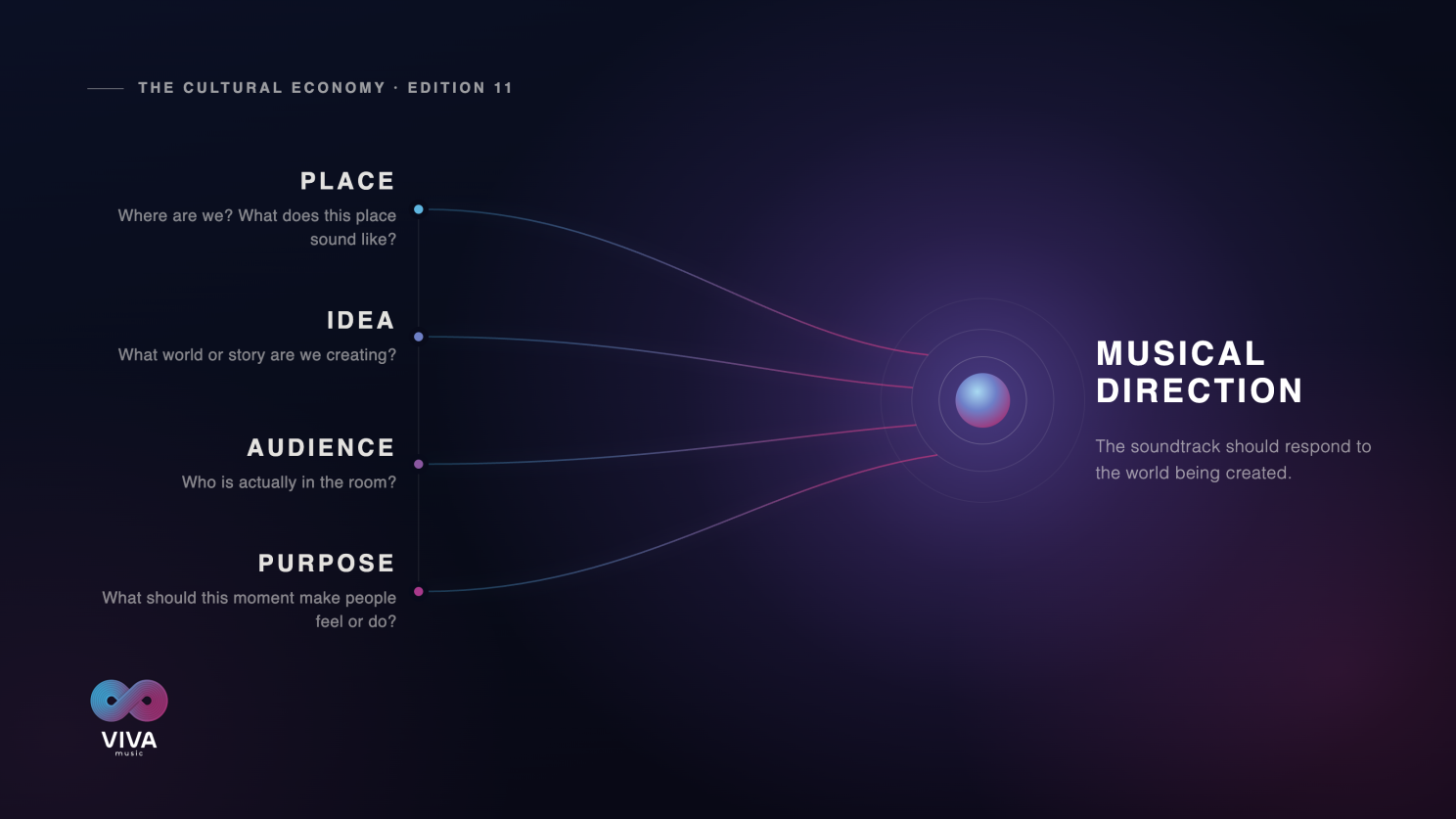
Before deciding who belongs on the stage, decide what world you are asking the audience to enter.
Culture is not a category in an entertainment catalogue
This becomes even more important when events are trying to reflect a place or culture.
The shorthand is familiar.
Indian audience? Bollywood.
Arab event? Oud player.
Luxury reception? Saxophonist.
Wellness? Handpan or sound healing.
Young audience? DJ.
None of those choices is inherently wrong.
Sometimes the obvious answer is the correct one.
The problem begins when the category becomes the thinking.
Because an Indian audience is not one musical audience.
Neither is an Arab audience.
Neither are “Gen Z”, “luxury consumers” or “corporate guests”.
Consider how strange the equivalent would sound elsewhere.
Imagine telling the food team:
"There are Europeans attending, so please arrange European food."
Or telling the design team:
"It is a luxury event, so make everything gold."
We would immediately recognise that the brief lacks depth.
Yet culturally specific entertainment is still sometimes approached at roughly that level.
The better question is not:
What entertainment represents this nationality?
It is:
What cultural language makes sense for these particular people, in this particular place, for this particular idea?
That creates much more interesting possibilities.
A traditional instrument might meet electronic production.
A regional musical tradition might be interpreted by a contemporary artist.
An emerging local scene might make more sense than a familiar heritage performance.
Two cultures represented in the room might meet through collaboration rather than being given separate ten-minute segments.
Or the culturally obvious choice may not be needed at all.
Authenticity does not always mean tradition.
Sometimes authenticity means understanding what a culture sounds like now.
The audience is more complicated than its demographics
This feels particularly relevant in cities such as Dubai, where a single event can contain an extraordinary mixture of nationalities, generations and cultural references.
The instinctive solution can be to play “something for everyone”.
Which often produces music that means very little to anyone.
Demographics tell us something about an audience, but not enough.
A more useful question is:
Why are these people together in this room?
Perhaps they are founders attending an entrepreneurship event.
Collectors at an art fair.
International buyers at a luxury launch.
Designers and architects.
People who have travelled specifically because they care deeply about a certain culture.
Those shared identities can sometimes tell us more about the appropriate musical language than nationality alone.
Events temporarily create communities.
Good programming understands the community the event is creating rather than simply trying to represent every demographic inside it.
Music can carry part of the narrative
The Paris 2024 Olympic Opening Ceremony gives us a much larger-scale example.
One of its most discussed sequences brought French metal band Gojira together with opera singer Marina Viotti for a new interpretation of the French revolutionary song Ah! Ça ira!, composed for the ceremony by musical director Victor Le Masne.
Metal.
Opera.
French revolutionary history.
Contemporary spectacle.
All inside the same moment.
Whatever one thought of the ceremony as a whole, this was not simply a famous band inserted into a programme.
The musical combination itself communicated something.
Historic France collided with contemporary France.
Opera met metal.
Institutional ceremony met rebellion.
Music became part of the story the event was telling about the culture it was presenting.
That is a useful distinction.
A performance can entertain an audience.
Programming can also say something.
The two are not always the same.
Sometimes music is not one department of the experience
Dubai's own Sole DXB offers another model.
Sole does not operate as though music happens on one stage while fashion, sport, design, film and brand activity happen in unrelated parts of the programme.
They belong to the same cultural world.
Its programming brings together live music, DJs, fashion, sport, art and conversation because those audiences and interests naturally overlap. Its 2023 partnership with Mass Appeal around the fiftieth anniversary of hip-hop was similarly framed around telling the story of hip-hop in the region, rather than simply assembling a collection of rappers under an anniversary banner.
That distinction matters.
People do not experience culture according to industry categories.
Someone interested in hip-hop may also care about sneakers, visual art, basketball, photography, fashion, dance and food.
Culture is interconnected.
The most interesting events understand those connections.
Which leads to a different starting question.
Instead of asking:
What entertainment should we add to this event?
Ask:
What culture is this event participating in?
Once that becomes clear, the musical choices often become clearer too.
An artist is not a strategy
There is a practical reason entertainment planning often begins with artist names.
Artists are tangible.
They have photographs. Showreels. Follower numbers. Technical riders. Fees. Availability.
They fit neatly into a spreadsheet.
An idea such as “we want the room to move from curiosity to intimacy to celebration over three hours” is much harder to procure.
So the industry naturally creates categories:
DJ.
Band.
Singer.
International act.
Headliner.
Those categories are useful operationally.
But they can also create an unintended effect:
The solution is selected before the problem has been properly defined.
A brilliant artist can be completely wrong for an event.
A relatively unknown artist can be perfect.
The most expensive artist is not automatically the most memorable.
And sometimes the talent is excellent, but the context fails them.
Imagine booking an extraordinary instrumentalist and placing them in the middle of a cocktail reception where 400 people have specifically been encouraged to network.
The musician performs beautifully.
The audience talks.
Nobody has necessarily done anything wrong.
But the audience has one job and the artist has another.
The room itself contains a conflict.
The issue was never talent.
It was programming.
Perhaps the music brief should come before the artist brief
What might happen if events created a music brief before requesting artist options?
Not an enormous strategy document.
Just a few better questions.
What should people be doing?
Are they listening?
Talking?
Eating?
Moving through a space?
Waiting?
Watching?
Dancing?
Discovering?
Participating?
Music intended for attentive listening is fundamentally different from music intended to support conversation.
What should people feel?
Not throughout the entire event.
At each stage.
Arrival might require curiosity.
A conference opening might need momentum.
A memorial moment requires space.
A product reveal may require anticipation.
Dinner may need warmth without demanding attention.
A final performance might provide release.
An event does not have one mood.
It has an emotional arc.
Where should attention go?
Sometimes music should take over the room.
Sometimes its job is to make something else work better.
Those are equally valuable roles.
A beautifully curated recorded soundtrack can be a better creative decision than a live performer if nobody is meant to be watching a performance at that moment.
What does the place contribute?
What city are we in?
What neighbourhood?
What venue?
What musical histories already exist there?
What contemporary scenes are developing there now?
Could the event enter that culture rather than simply occupy its physical space?
What does the host actually stand for?
If a brand talks constantly about experimentation, why is its entertainment completely predictable?
If an organisation presents itself as locally rooted, why does nothing in the musical programme connect with the local creative community?
If an event wants to champion emerging culture, why does all its entertainment investment go towards familiarity?
The sound should not contradict the story the rest of the event is trying to tell.
What happens between the “important” moments?
This may be one of the most overlooked questions.
The five-minute reveal gets rehearsed repeatedly.
The 45 seconds before it may receive almost no attention.
But audiences do not experience an event as a production schedule.
They experience it continuously.
The walk-in.
The waiting.
The speaker changeovers.
The room reset.
The pause before an announcement.
The period after dinner.
The moment the formal programme ends.
The exit.
Those are not empty spaces.
They are part of the experience too.
Who owns the musical experience?
Film has composers and music supervisors.
Fashion has specialists such as Michel Gaubert who translate creative direction into sound.
Concerts and festivals have artistic directors, programmers and talent buyers.
Hospitality businesses increasingly think about music programming as part of atmosphere and identity.
And at the highest levels of experiential production, this kind of thinking already exists. The opportunity is to make it more common across the broader events market.
Responsibility for music can still be fragmented.
The creative agency develops the concept.
The client approves it.
An entertainment company supplies performers.
An agent handles the artist.
A DJ manages another part of the evening.
The production company manages sound.
Everyone owns a piece.
It is not always obvious who owns the musical experience as a whole.
There may be room for something closer to music direction for events.
Not for every conference coffee break or corporate dinner.
But for events where experience, culture and memory genuinely matter.
The role would begin before the shortlist.
It would translate the event idea into a musical one.
It might recommend a major artist.
Or three emerging artists.
An unexpected collaboration.
A commission.
A DJ.
A live ensemble.
A carefully designed recorded soundtrack.
Or silence.
The important thing is that the answer follows the idea rather than preceding it.
Better thinking does not necessarily mean a bigger entertainment budget
Treating music more creatively does not require every event to commission an orchestra or book a global superstar.
Thoughtful programming can sometimes make a modest budget far more distinctive.
Instead of putting almost the entire budget into one recognisable artist, an event might create a collaboration between two less obvious ones.
Instead of importing a generic act, it could work with an artist from the local scene.
Instead of booking one performer for four hours, it could create different musical chapters across the evening.
Instead of treating the venue simply as a room, it could programme music that responds to its history or architecture.
Or instead of another predictable background act, it could decide that conversation deserves space.
At the opposite end of the scale, Cercle shows what happens when artist, location, visual environment, sound and audience experience are designed together.
Most events neither need nor have the resources for that level of production.
But the interesting lesson is not the technology.
It is the integration.
Sound, visuals, artist, audience behaviour and space are being designed as one experience.
That principle does not require a huge budget to understand.
From entertainment to experience design
None of this means every event needs to become an artistic experiment.
Sometimes the brief genuinely is:
We need a very good DJ. We need a reliable band. We want people dancing until midnight.
There is nothing unsophisticated about executing a straightforward objective extremely well.
The mistake would be pretending every entertainment booking requires a grand cultural thesis.
But the opposite mistake exists too.
When organisations spend months designing experiences intended to create emotion, identity and memory, music should not automatically be reduced to the final supplier category on the spreadsheet.
Because guests do not experience an event as separate departments.
They do not leave thinking:
That was excellent stage design. That was an effective lighting package. That was a strong talent booking.
They experience one thing.
One evening. One atmosphere. One sequence of moments.
Music moves through almost all of them.
That is why the cinema analogy matters.
Change the score and the same scene can become romantic, frightening, triumphant, melancholy or absurd.
Live experiences are not so different.
We spend enormous effort thinking about how an experience should feel.
Perhaps its soundtrack deserves to enter that conversation a little earlier.
Because every event already has one.
The real question is whether it happened by accident, or whether somebody designed it.
Kavya Yadav writes The Cultural Economy and leads Viva Music, a music consultancy and cultural platform working across artist strategy, live music, brand partnerships, cultural programming and the development of stronger music ecosystems.
Originally published in The Cultural Economy on LinkedIn on August 17, 2026.