

From Hosting Culture to Building a Real Creative Economy
There is a pattern that repeats across cities that want to matter culturally. A government announces a landmark festival. The lineup is impressive. The production is world class. International press arrives. For one weekend, the city is the centre of the cultural conversation.
Then everyone flies home.
And the question that decides everything comes next. What did the city keep?
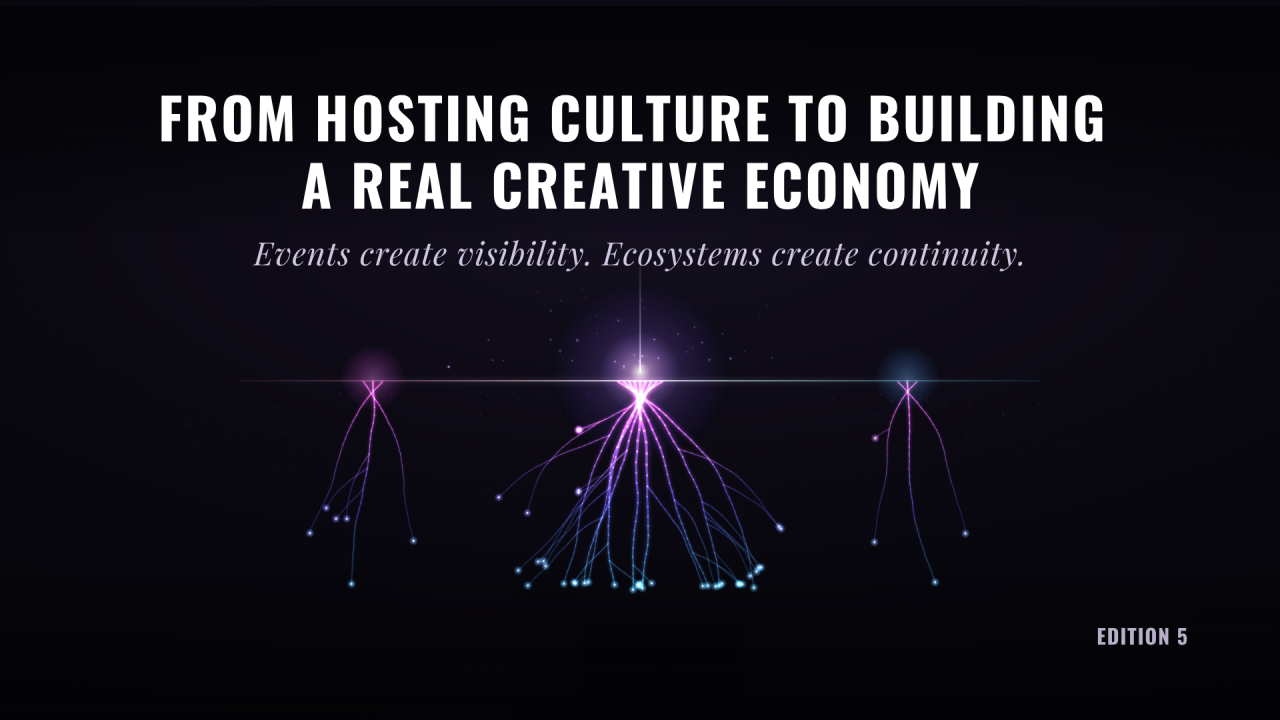
Events create visibility. Ecosystems create continuity. The cities that become cultural capitals understand the difference. Cities that struggle usually confuse visibility with continuity.
This edition is about that difference. What it looks like, what it requires, and why the next great cultural capital will be built in the space between event days.
For a city like Dubai, this question is not theoretical. Dubai already has the policy ambition, tourism base, hospitality infrastructure, creative districts, capital and multicultural audience that many cultural cities spend decades trying to assemble. The next opportunity is not simply to host more culture. It is to make sure more cultural value stays, compounds and turns into a real creative economy.
Five cities, one lesson
Austin branded itself the Live Music Capital of the World and built festivals that generate major economic impact. But the city's own music economy research found the local music economy under pressure even as music tourism grew. Between 2010 and 2014, music-related tourism jobs rose 37 percent, while non-tourism, year-round music jobs fell 15 percent.
A decade later, even SXSW has had to rethink its model, shorter on the calendar, more integrated across music, film, tech and culture, with music continuing inside that broader platform. The tourism layer boomed while the production layer thinned. The brand risked outliving the thing it was built on.
The UK ran the same experiment at national scale. British music is a multibillion-pound export, and nearly all of it started in small rooms. In 2024, UK music contributed £8 billion to the economy, generated £4.8 billion in export revenue and supported 220,000 full-time equivalent jobs.
But in 2025, over half of the country's grassroots venues made no profit and many towns lost regular access to touring artists. The industry's response is the interesting part. A voluntary financial pipe is being tested between the top and bottom of the live sector through arena and stadium ticket contributions, artist donations, venue support funds and industry-backed mechanisms redirected into small venues and emerging artists.
Read that plainly. One of the world's most successful live music markets is now confronting the fact that its stadiums cannot survive without its pub back rooms.
The pipeline is the product.
Seoul proves the inverse. K-pop did not go global because Korea hosted a big festival. It went global because private entertainment companies, training systems, production infrastructure, government-backed export support, media infrastructure and content policy started reinforcing one another over two decades.
The events came after the ecosystem, as its output. Today Korean culture pulls billions in exports and reshapes tourism, beauty, food and fashion demand worldwide. South Korea's content exports reached an estimated record 14.9 billion dollars in 2025.
Berlin took a different route to the same destination. Its club scene grew from cheap space, post-wall experimentation, permissive urban conditions and a city that eventually began recognising nightlife as culture. Berlin's techno culture was added to Germany's national inventory of intangible cultural heritage in 2024.
The result is a cultural economy where visitors come for the scene itself, not for any single event.
And Lagos shows the power of culture before infrastructure fully catches up. Afrobeats travelled through raw talent, producers, clubs, radio, diaspora networks, digital platforms, social media and relentless entrepreneurial energy.
But the wider African live ecosystem still faces venue gaps, expensive production, fragmented touring routes, visa friction and difficult intra-African touring economics. Imagine the output if the infrastructure matched the talent at full scale.
That gap, between what a culture produces naturally and what it could produce with deeper support, is exactly the opportunity ambitious cities should be studying.
Five different cities. One lesson. Culture that lasts is built on systems, not moments.
The anatomy of an ecosystem
Strip away the strategy documents and the chain looks like this.
Creators need a reason to stay. Not just visas and licences, though those matter, but affordable rehearsal space, recording infrastructure and a realistic path from first performance to sustainable income. A city where an emerging artist cannot afford to practise is a city quietly exporting its own talent.
Small and mid-size rooms matter more than flagships. Every city wants an arena. Few cities protect the 150-capacity room where an unknown act plays to forty people. But that room is where artists develop, where scenes form and where audiences learn to take risks on new work.
The UK data shows what happens when this layer erodes. The pipeline breaks years before the damage shows at the top.
Money has to reach creators cleanly. When a song plays in a hotel, a cafe or a festival, someone should get paid, and everyone involved should know how. Cities that make this simple do not just attract performers. They attract the rights businesses behind music, publishers, labels, catalogue owners, sync agencies and licensing platforms.
Cities that leave it murky push the whole value chain elsewhere. This is plumbing, not poetry, but it decides where the industry physically locates itself.
Education only strengthens a cultural economy when it is connected to local opportunity. Music schools and production courses matter, but they cannot build an ecosystem on their own. Graduates need nearby venues, studios, labels, publishers, festivals, agencies, media companies, hospitality programming, brand work, teaching opportunities and paid creative projects.
Otherwise, the city risks training talent for other markets.
The corporate money is already there. The pipe is missing.
Here is the part many cultural strategies underestimate. Parts of the private sector want in, but cities rarely build the mechanism.
Brands spend enormous sums chasing cultural relevance, and most of it goes into advertising that audiences skip. Meanwhile, the actual sources of cultural relevance, the venues, the emerging artists, the scenes, sit underfunded a few kilometres from those same marketing departments.
This is not a funding shortage. It is an architecture failure.
Nobody built the pipe.
The models that work are surprisingly practical. The UK levy debate shows how revenue from the top of the live industry can be redirected into its own grassroots layer, even if the model is still uneven and voluntary.
Real estate developers increasingly understand that cultural programming can support footfall, dwell time, place identity and commercial attractiveness. Hospitality groups are learning that serious music programming can become a differentiator, and that partnering with local scenes is often more credible than simply importing entertainment.
Banks, airlines and telecoms that sponsor emerging artist platforms, rather than only headline concerts, buy something advertising cannot. They become part of an artist's origin story, and audiences remember who showed up early.
Both sides win when the structure exists. Brands get cultural equity instead of rented attention. Creators get funding that does not depend only on grant cycles. The city gets a more resilient, less grant-dependent cultural sector.
What is missing in many markets is not willingness but design, clear entry points, credible intermediaries and measurable outcomes that let a CFO say yes.
Culture is soft power with a balance sheet
The strategic payoff extends far past the creative sector itself.
Korea's cultural wave transformed the country's global image within a generation, and pulled tourism, exports and diplomatic weight along with it. The UK, France and Japan spend heavily to maintain cultural institutions abroad because cultural presence converts into influence, trade relationships and talent flows.
Few forms of soft power travel as quickly as a globally loved song, film or scene.
Tourism boards understand part of this. Events fill hotel rooms. But ecosystems change the shape of tourism itself. A festival brings visitors for a weekend. A living scene brings them year round, brings them back, and brings a different kind of visitor, one who stays longer, spends deeper and tells better stories about the city.
Berlin's visitors do not come for one date on a calendar. They come for what the city is on any given night.
And in the global competition for skilled workers, culture has quietly become a deciding factor. Talented people choosing between cities increasingly choose the one that feels alive after work.
The creative economy already accounts for roughly 3.1 percent of global GDP and around 6 percent of global employment, with creative services exports at a record 1.4 trillion dollars. But its second-order effect may be larger. It is the sector that makes every other sector's recruitment easier.
Where ambitious cities go from here
The encouraging news is that a new generation of cities treats culture as economic policy rather than decoration, and the Gulf is the clearest example.
Dubai set a target for creative industries to reach 5 percent of GDP, backed it with creative districts, long-term cultural visas and a formal measurement approach for the creative economy. Its creative economy contributed 21.9 billion dirhams to GDP in 2022, representing 4.6 percent of Dubai's total economy, and supported over 175,000 jobs.
Saudi Arabia is building entertainment and tourism infrastructure at significant scale under Vision 2030. These are serious, funded, measured commitments, and they have already achieved what many older cultural capitals never managed, political consensus that culture is an economic sector.
The next chapter for every city at this stage is the same. The events layer and the flagship infrastructure exist. The connective tissue between them is the frontier.
The rehearsal room economy. The small venue circuit. The systems that let a cafe, a hotel and a festival all pay artists correctly. The mechanisms that let corporate money fund grassroots culture without waiting for grant cycles. The data that shows, quarter by quarter, whether the ecosystem is thickening or thinning.
For the UAE, one important part of that connective tissue is already taking shape. In 2025, the Ministry of Economy granted collective music management licences aimed at organising the collection and distribution of rights for music creators.
That matters because if hotels, restaurants, broadcasters, events and digital platforms can license music clearly, and creators can be paid transparently, the city becomes more attractive not only to performers, but to publishers, labels, catalogues and rights businesses.
None of this photographs well. Nobody cuts a ribbon for a functioning royalty system. But this is the layer that decides whether a city hosts culture or produces it.
The test
There is a simple test for whether a city is building an ecosystem or just a calendar.
Ask what a talented nineteen-year-old musician in that city can do on an ordinary Tuesday in the off season. Is there a room she can afford to rehearse in? A venue willing to book unknown acts? An engineer who can record her properly? A cafe, hotel, gallery or cultural space that can programme her music professionally?
Is there a clear system through which she gets paid when her work is used? A community of peers around her? And most importantly, are there people a few steps ahead of her who have been able to stay, grow and build real careers in the same city?
If the answer is yes, the city is building something that compounds. Every festival it hosts will leave residue, new collaborations, new signings, new rooms, new reasons to stay.
If the answer is no, the events will keep getting bigger while the culture underneath gets thinner, and the gap will stay invisible until it is expensive.
Music does not become culture on event days. It becomes culture on all the other days, in small rooms, through working artists, inside systems most audiences never see.
The cities that understand this are not choosing between events and ecosystems. They use the visibility, revenue and relationships created by the first to strengthen the second.
A city does not become a cultural capital because it hosts culture. It becomes one when it produces, protects and compounds it.
What should cities measure more seriously if they want culture to last beyond event days?
Kavya Yadav writes The Cultural Economy and leads Viva Music, a music consultancy and cultural platform focused on artists, brands, venues, audiences and the systems that help culture grow.
Originally published in The Cultural Economy on LinkedIn on July 2, 2026.