

Hospitality Is Becoming a Cultural Business
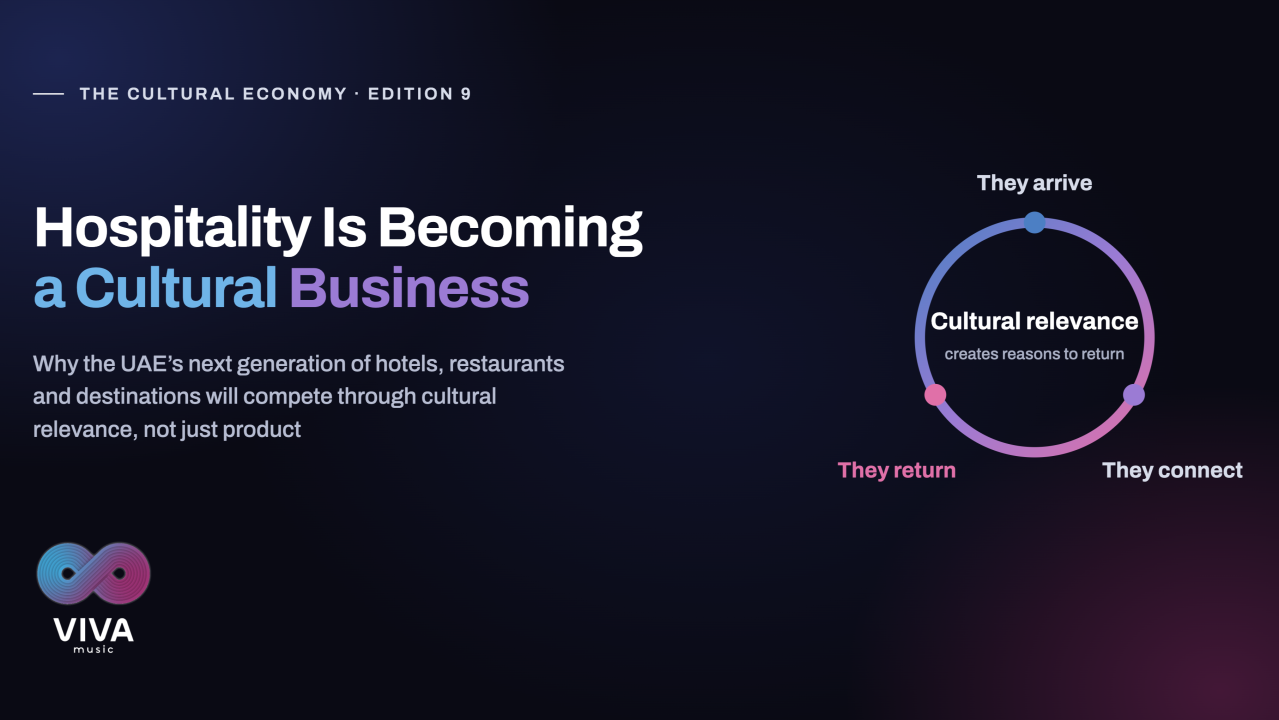
Why the UAE’s next generation of hotels, restaurants and destinations will compete through cultural relevance, not just product
Dubai does not have a shortage of beautiful places.
It has an abundance of them.
Beautiful hotels. Beautiful restaurants. Beautiful beach clubs. Beautiful rooftops. Beautiful wellness spaces.
That abundance is one of the UAE hospitality sector's greatest achievements.
It is also creating its next competitive challenge.
When the architecture is exceptional, the room is beautifully designed, the restaurant is led by a serious chef and another luxury property opens a few kilometres away, what actually makes one place more compelling than another?
Increasingly, the answer cannot come from the physical product alone.
It has to come from what the property makes possible.
The problem created by success
This is not an argument built around weakness in UAE hospitality.
Quite the opposite.
Dubai welcomed a record 19.59 million international overnight visitors in 2025, 5 per cent more than the previous year. Across the UAE, hotel performance had been exceptionally strong, with Knight Frank reporting average occupancy of 78.5 per cent in the year to August 2025 and double-digit growth in both ADR and RevPAR. Dubai Department of Economy & Tourism
And the market is continuing to expand.
Knight Frank expects the UAE to have approximately 235,700 hotel rooms by 2030. More tellingly, 43 per cent of future supply is expected to be in the luxury segment. Knight Frank AE
That means the question facing hospitality operators is not simply:
How do we create a better hotel?
It is increasingly:
How do we create a stronger reason to choose this hotel?
There is a difference.
A beautiful pool is valuable. But there are many beautiful pools.
A Michelin-recognised restaurant is valuable. But the UAE now has an increasingly sophisticated dining landscape.
A rooftop view is valuable. But another rooftop will open.
Physical differentiation has not disappeared. It has simply become harder to own.
The next layer is cultural differentiation.
Travellers are increasingly buying a reason, not just a destination
Some of the most useful travel research going into 2026 is less about where people want to travel and more about why they travel.
Hilton describes this as the rise of the "whycation", where journeys increasingly begin with an emotional motivation: to reconnect, recover, discover, celebrate or pursue a personal interest.
Among UAE travellers surveyed, 73 per cent said they actively seek experiences that allow them to engage with local customs they had not researched before travelling. Hilton's wider global research found travellers increasingly looking for meaningful experiences alongside the comfort and consistency they still expect from hospitality brands. Stories From Hilton
Booking.com's 2026 research, covering nearly 30,000 travellers across 33 countries and territories, points towards the same fragmentation of demand. Travel is becoming more individual, more passion-led and more expressive of personal identity. Booking News
And Expedia's latest 2026 research demonstrates something even more commercially interesting: live events, concerts, sporting moments and screen culture are increasingly influencing where people travel and how they structure hotel stays.
This changes the relationship between hospitality and experience.
Traditionally, the logic has often been:
The guest chooses the destination, books the hotel, and then looks for something to do.
Increasingly, that sequence can run in reverse.
Something worth experiencing can become the reason to visit, dine, stay or travel.
That is a significant opportunity.
Hospitality has always sold more than inventory
A room night is inventory.
A restaurant table is inventory.
A spa treatment is inventory.
But hospitality has never created its greatest value from inventory alone.
It creates value around how people feel while occupying it.
This is why two technically comparable properties can produce completely different levels of attachment.
Guests remember particular things.
The dinner they could not have had elsewhere.
The musician they discovered unexpectedly.
The chef who came to their table.
The evening that changed character after sunset.
The conversation that continued for two hours longer than expected.
The artist whose work made them understand something about the destination.
The sense that they happened to be somewhere at exactly the right moment.
Hospitality operations rightly strive for consistency.
Human memory does not work quite the same way.
Research published in the Journal of Business Research, examining more than 5,000 hotel stays, found that first impressions, peak moments and final impressions exert disproportionate influence over how guests evaluate the overall experience.
The implication is important.
Consistency protects the experience. Distinctive moments can define it.
Cultural relevance is not another word for entertainment
This is where the conversation often becomes too narrow.
Cultural programming does not simply mean putting more entertainment into hotels.
A DJ can be cultural programming.
Or it can simply be a DJ.
An art exhibition can be culturally meaningful.
Or it can simply fill a wall.
A celebrity chef collaboration can create genuine demand.
Or it can become another marketing activation that disappears from memory the following week.
The format does not determine the value.
The thinking behind it does.
A one-night performance can be strategically brilliant.
A weekly programme can become irrelevant.
An annual event can acquire enormous cultural equity.
A three-month residency may be right for another property.
A spontaneous thirty-minute intervention may create the most memorable moment of someone's entire stay.
There is no intrinsically superior cadence.
The more useful questions are:
Why should this happen here?
Why would this audience care?
What does it add to the experience of the property?
What becomes possible because the property created it?
And perhaps most importantly:
Would anyone notice if we replaced it with something generic?
If the answer to the last question is no, it probably isn't differentiation.
From events to occasions
Hospitality professionals already understand the commercial power of an occasion.
Friday night.
Sunday brunch.
Eid.
A wedding anniversary.
A long weekend.
Sunset.
A birthday.
A visiting friend.
A major sporting weekend.
People do not always leave home because they need food, accommodation or entertainment.
Often they leave because they need a reason for the evening to exist.
That is where programming becomes commercially interesting.
A restaurant can sell dinner.
Or it can create a dinner people organise their week around.
A resort can sell a weekend.
Or it can create a particular weekend that becomes difficult to substitute.
A hotel can have a lobby bar.
Or on one evening, that lobby can become somewhere the city wants to be.
The difference is not necessarily capital expenditure.
It is conception.
What could this look like?
The opportunity becomes much more interesting when hospitality moves beyond the familiar event calendar.
Imagine a desert property creating one night around the sound of darkness.
Guests arrive before sunset. A composer develops a piece around the transition from day into night. An astronomer interprets what appears above them. Arabic poetry becomes part of the narrative. Dinner follows the same progression.
It works because of where it happens.
Imagine a restaurant commissioning a five-course conversation between a chef and a musician.
Not background music during dinner.
The menu and composition are developed together, tension, silence, rhythm, intensity and release moving through both.
Perhaps it happens once.
That may be precisely why people want to be there.
Imagine a coastal resort creating a night of the tide, bringing together marine ecology, visual art, food and sound around the environment immediately outside the property.
Imagine a heritage hotel opening its archives for one evening and reconstructing the neighbourhood through photographs, oral histories, food, letters and contemporary interpretation.
Imagine a luxury urban hotel creating After Hours, where a very small group gains access to the city's creative life after ordinary opening hours: a private studio, rehearsal, atelier, collection, kitchen or architectural space, followed by a gathering back at the hotel.
Imagine a wellness property commissioning a musician to build an intentional listening experience around silence, acoustic space, breath and live instrumentation, rather than importing another standardised wellness format.
Imagine a hotel inviting an Emirati artist and an international artist staying in the property to create something together for one night only.
Imagine a restaurant giving its dining room to a filmmaker, perfumer, architect or poet and asking:
If dinner belonged to your discipline for one evening, what would it become?
Not all of these should become permanent.
Some should disappear.
That transience can be part of their value.
Others may prove so resonant that guests ask for them again.
Then a one-off becomes a series.
A series becomes a signature.
A signature can eventually become part of the property's identity.
That evolution should be earned, not predetermined.
Global hospitality is already moving in this direction
Some of the world's strongest hospitality brands are demonstrating different versions of the same idea.
Belmond's Villa San Michele reopened in Florence this year with much more than renovated rooms. Its 2026 season includes open-air concerts with the local music school, creative workshops, Tuscan wine gatherings and an immersive collaboration with La DoubleJ.
At another Belmond property, La Residencia in Mallorca, a partnership with the LOEWE FOUNDATION is bringing three artists into two-month residencies, with work responding to Deià and the surrounding Tramuntana landscape.
Aman New York integrates its Jazz Club directly into a 2026 stay experience alongside dining and wellness. Here, music is not sitting outside the hospitality product. It is part of the reason the package exists.
At Patina Maldives, the Fari Islands Festival this August combines live performance, immersive dining, creative practice, wellness and nature across a multi-day destination experience.
And the direction is visible much closer to home.
Rosewood's forthcoming Dubai property explicitly describes immersive art, music and culinary programming as part of its ambition to become a cultural and social hub, alongside the traditional luxury components of beach, dining, wellness and accommodation.
These examples are useful precisely because they are not identical.
One is music.
One is art.
One is a festival.
One is a residency.
One is seasonal programming.
Some are ongoing.
Others are episodic.
The commonality is not format.
It is the recognition that culture can sit inside the hospitality proposition rather than beside it.
This is particularly relevant to the UAE
The UAE has something few hospitality markets possess at this scale.
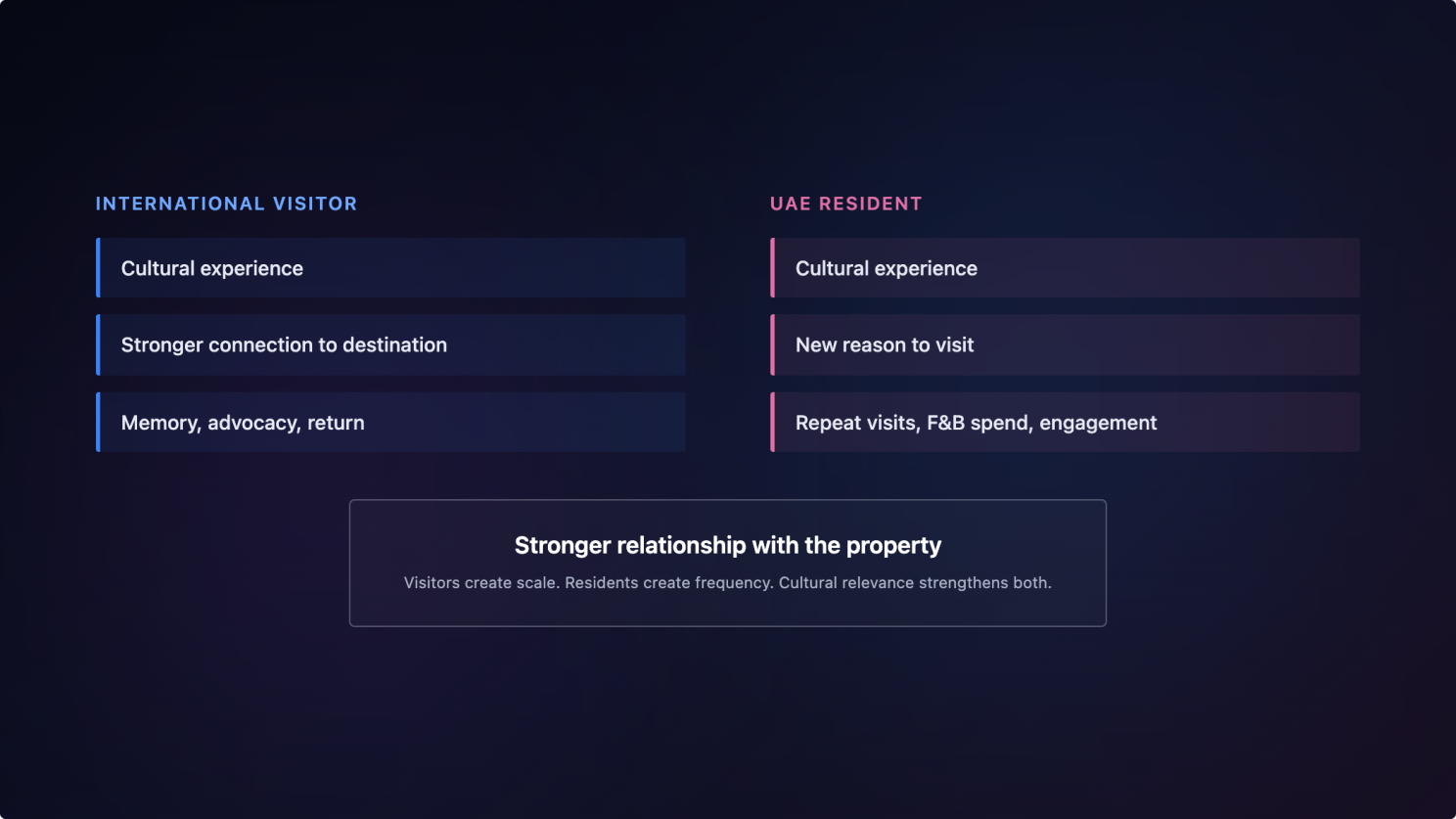
It has an enormous international visitor economy and an extraordinarily diverse resident population occupying the same hospitality ecosystem.
That creates two valuable, but different, audiences.
For an international visitor, cultural relevance can provide access to the destination.
For a resident, it can provide access to something new within a destination they already know.
The visitor might ask:
What can I experience here that tells me something about Dubai?
The resident asks a different question:
What is happening in Dubai that is worth leaving home for?
A compelling hospitality concept can answer both.
And 2026 has made the resident dimension more visible.
Regional disruption has put pressure on international travel and hotel performance. CBRE reported sharp year-on-year declines in UAE hotel occupancy and RevPAR through June, with operators responding through staycation offers and domestic tourism campaigns. CBRE
Industry operators have also reported shorter booking windows, more selective spending and stronger reliance on UAE and GCC demand. Importantly, many are responding not purely through discounting, but with more considered, experience-led propositions. The National News
This should not be misread.
UAE hospitality has not suddenly become resident-led.
International tourism remains fundamental to the sector.
But the current environment has highlighted something strategically valuable:
International visitors create scale. Residents can create frequency.
A property capable of being meaningful to both occupies a stronger position than one that exists only inside the tourist economy.
And the UAE's idea of "local" is unusually interesting
Cultural relevance in the UAE should also not be confused with simply adding heritage references.
Heritage matters enormously.
But contemporary culture is not frozen in the past.
Dubai in particular is being created every day through an unusual intersection of people, languages and traditions.
Emirati culture.
The wider Arab world.
South Asia.
Africa.
Iran.
The Philippines.
Europe.
East Asia.
And an almost continuous movement of international visitors through all of them.
That creates extraordinary programming material.
The story of the creek and trade.
The relationship between desert and city.
Contemporary Arab creativity.
South Asian cultural influence in the Gulf.
Food migration.
Architecture.
Fashion.
The sea.
Poetry.
New forms of wellness.
The cultures of people who built lives here.
The perspectives of people who are here for seventy-two hours.
The UAE does not need to fabricate cultural complexity.
It already possesses it.
The opportunity is to curate it intelligently.
Cultural relevance can also solve a commercial problem
This is where the conversation becomes more than brand theory.
A hotel is not simply a collection of bedrooms.
It is an asset containing multiple commercial environments.
Restaurants.
Bars.
Spas.
Pools.
Beach clubs.
Ballrooms.
Terraces.
Gardens.
Rooftops.
Retail.
Private dining rooms.
Meeting spaces.
Sometimes even areas that are barely used outside particular hours.
The question is not merely how to fill these spaces.
That risks producing programming for programming's sake.
The more useful question is:
Can a cultural idea unlock demand for a part of the asset in a way that feels additive rather than promotional?
Sometimes that means F&B revenue.
Sometimes it means a stay package.
Sometimes a culturally significant one-night concept creates an audience that had never entered the hotel before.
Sometimes it creates media value.
Sometimes a brand partnership underwrites the experience.
Sometimes it gives a concierge something genuinely interesting to recommend.
Sometimes it extends dwell time.
Sometimes it gives a resident a reason to discover the property.
Sometimes it makes an existing guest decide not to leave.
And occasionally the experience itself can generate direct revenue.
There is no single commercial model because there is no single strategic purpose.
The mistake is judging every cultural concept by ticket sales alone.
The opposite mistake is pretending commercial outcomes do not matter.
Good hospitality programming understands both sides.
Culture does not rescue weak hospitality
There is an important limit to this argument.
Cultural programming cannot compensate for a poor core product.
Bad service with an excellent performance is still bad hospitality.
An ordinary restaurant with a famous musician remains an ordinary restaurant the next morning.
Guests will not forgive operational failures because the artistic concept was intelligent.
The fundamentals remain non-negotiable.
Location.
Service.
Food.
Design.
Comfort.
Pricing.
Operations.
But when those fundamentals are already strong, cultural relevance can make them more distinctive.
That is the opportunity for the UAE.
Not to replace product with programming.
To make strong product mean more.
Perhaps "programming" is not even the most useful word
Programming can sound like a calendar.
What hospitality is really creating is moments of cultural relevance.
Some last thirty minutes.
Some last a weekend.
Some return every season.
Some become permanent.
Some should happen once and never again.
The sophistication lies in understanding which is which.
A one-night collaboration should not be forced into a residency simply because recurrence sounds more strategic.
A concept guests genuinely love should not be discarded simply because it was originally designed as a one-off.
The idea should determine the format.
The property should determine the context.
The audience should determine the tone.
The commercial objective should determine how success is measured.
That is curation.
And curation may become one of the most valuable hospitality capabilities in a market already overflowing with choice.
The next competitive layer
Hospitality competition will continue to revolve around the fundamentals.
Better rooms.
Better food.
Better service.
Better locations.
Better design.
But once an industry reaches the level of sophistication the UAE has reached, another question inevitably emerges:
What does this place stand for beyond the things it sells?
Does something happen there that could not simply be transplanted into another hotel?
Does it participate in the cultural life around it?
Does it give visitors access to the destination rather than insulating them from it?
Can residents develop a relationship with it even when they are not booking a room?
Can a Tuesday evening suddenly become culturally significant because something exists there that night and nowhere else?
Can someone leave saying:
"You had to be there."
That sentence may be one of hospitality's most powerful forms of marketing.
Because it cannot be manufactured through media spend alone.
Something actually had to happen.
The strongest hospitality properties of the next decade will not all become cultural institutions.
Nor should they.
But more of them will understand that culture can create demand, memory, distinction and connection in ways physical amenities alone cannot.
Sometimes through a signature programme.
Sometimes through an extraordinary collaboration.
Sometimes through a recurring ritual.
Sometimes through one exceptional evening.
For the traveller, it can make the hotel part of the destination.
For the resident, it can make the hotel part of the city.
And for the hospitality business, it creates something increasingly difficult to buy:
a reason to choose this place, at this moment, over all the other excellent places available.
That is where cultural relevance becomes commercial relevance.
And that is where hospitality becomes part of the cultural economy.
Kavya Yadav writes The Cultural Economy and leads Viva Music, a music consultancy and cultural platform working across artist strategy, live music, brand partnerships, cultural programming and the development of stronger music ecosystems.
Originally published in The Cultural Economy on LinkedIn on August 6, 2026.