
A Lineup Is Not a Festival
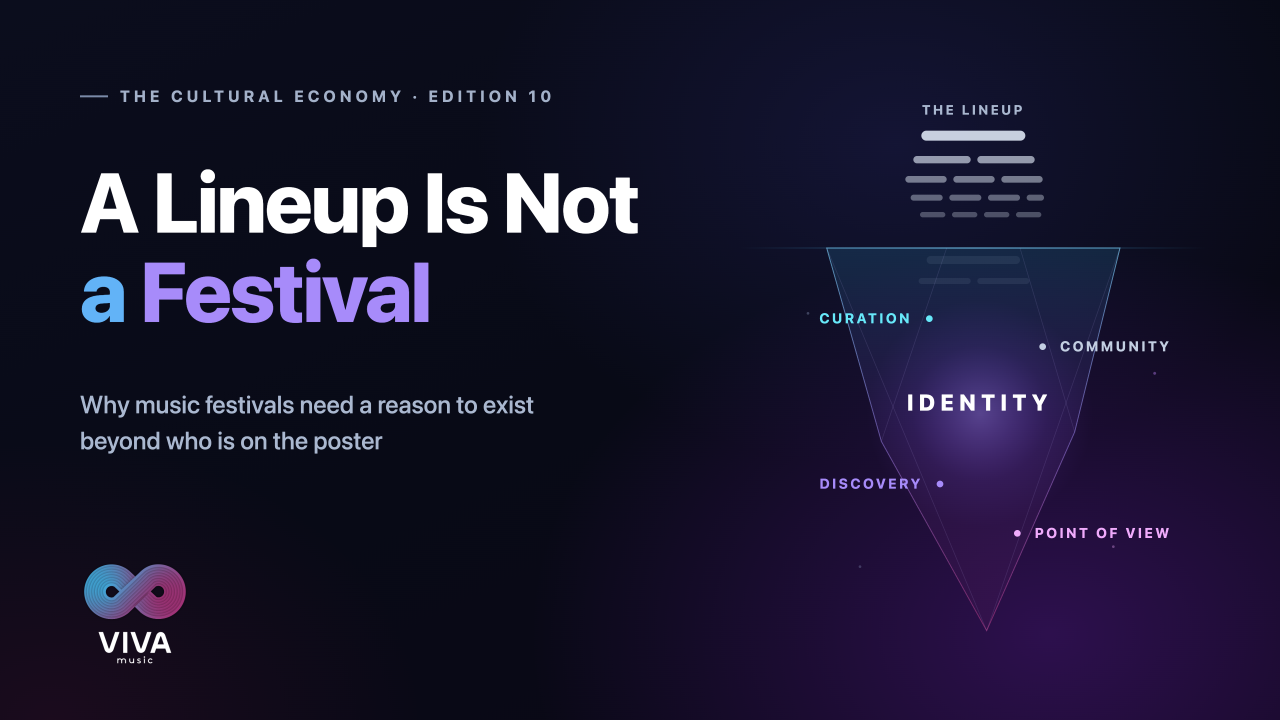
Why music festivals need a reason to exist beyond who is on the poster
Here is a useful test for any music festival.
Take its poster and remove every artist's name.
Would you still know what festival it is?
Would you know who it is for? What kind of music it believes in? What you might discover there? What the experience will feel like? Why an artist would particularly want to play it? Why a brand would want to be associated with it?
Most importantly, would there still be a reason to go?
If the answer to most of those questions is no, the festival may have a lineup. It may even have a very good lineup.
But it may not yet have much of a festival.
This matters because festival calendars are getting crowded. Artists tour across markets, often appearing on multiple festival bills during the same season. Audiences have more concerts, festivals and entertainment choices competing for the same time and money.
So if the only convincing answer to "Why this festival?" is "because these artists are playing", the festival has built very little that actually belongs to itself.
The lineup trap
There is nothing wrong with booking big artists.
Headliners sell tickets. They create attention, give sponsors confidence, attract media coverage and can transform the commercial prospects of an event.
The problem begins when the lineup becomes the festival's entire proposition.
Because if artists are your identity, you have to buy that identity again next year.
And the year after that.
The artist does not belong to the festival. They can play another festival a few weeks later. Their fee can rise. Their touring plans can change. A competitor can book them. Their popularity can decline.
In effect, the festival is borrowing cultural relevance from the artists it books instead of building enough cultural relevance around its own name.
That becomes especially problematic when promoters facing commercial pressure gravitate towards the same pool of proven acts.
MIDiA Research has written about this growing homogenisation in festival programming, arguing that risk aversion can drive promoters towards familiar names even as increasingly similar lineups weaken the distinctiveness of individual festivals.
There is a strange paradox here.
Trying to reduce programming risk can create another kind of risk: becoming interchangeable.
When every promoter asks, "Who can sell the most tickets?", eventually many posters begin answering the question in roughly the same way.
But audiences do not experience ten festival posters as ten independent spreadsheets.
They compare.
Why travel to this one?
Why spend the weekend here?
Why choose this festival over another one featuring several of the same artists?
The safest booking decision in isolation may not always produce the strongest festival when everyone else is making the same safe decision.
What does a festival actually own?
Not the artists.
Often not the venue.
Certainly not the audience's attention.
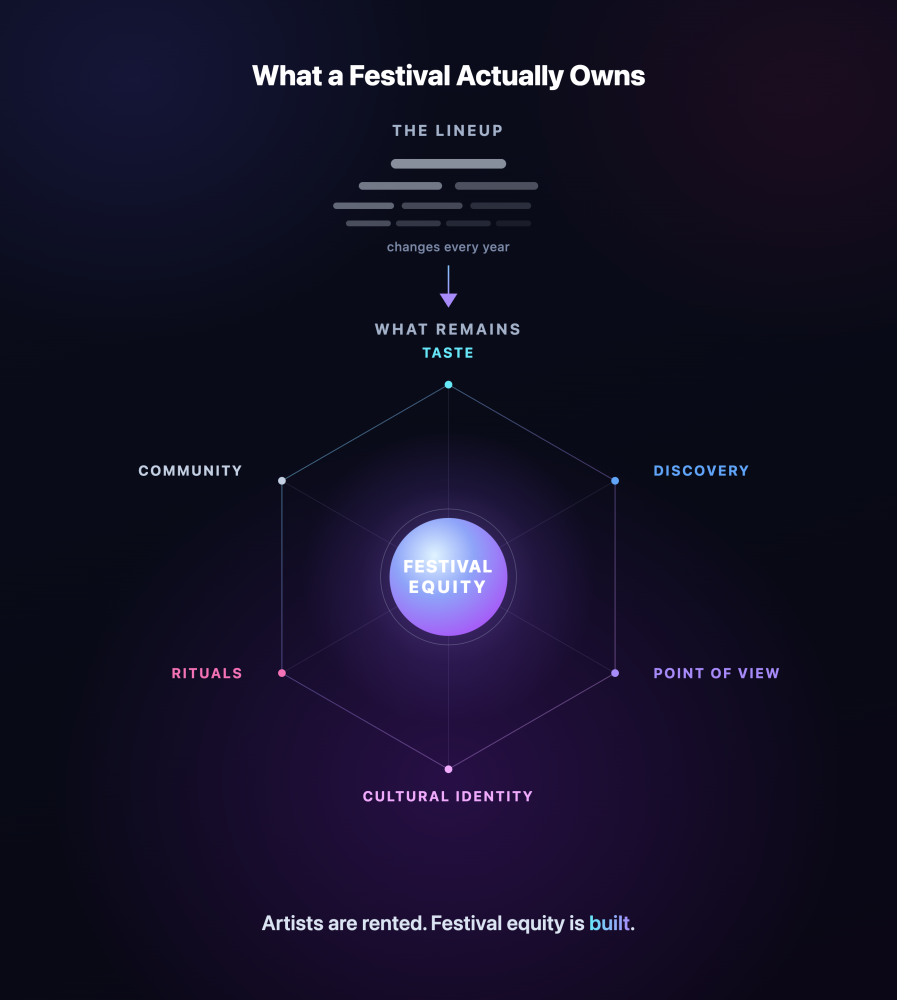
What a festival can own is something more difficult to create:
a point of view.
Its taste.
Its reputation.
Its relationship with a particular audience.
Its rituals.
Its visual and cultural language.
Its understanding of a scene.
Its reputation for discovery.
Its way of presenting artists.
Its collaborations.
Its community.
Its values.
The feeling people expect when they arrive.
And eventually, the trust that if this festival has programmed something, perhaps it is worth paying attention to.
These things are sometimes dismissed as the softer cultural layer surrounding the commercial product.
I think that gets the economics backwards.
They are part of the product.
A clearly defined festival makes several decisions easier at once.
The audience understands whether it belongs there.
Artists understand what appearing there means.
Brands understand the cultural context they are entering.
The media has something to discuss beyond the lineup announcement.
And the promoter has begun creating demand that is not entirely dependent on whichever artist is most expensive that year.
The extreme example is Glastonbury. Tickets for its 2025 edition sold out in around 35 minutes, before any headliners had been announced.
Obviously, few festivals have Glastonbury's history, scale or cultural capital. It would be meaningless to tell a new festival to simply replicate it.
But the underlying principle is worth noticing.
Those buyers were not purchasing a specific headliner.
They were buying Glastonbury.
That is festival equity.
The lineup still matters enormously. But the festival itself has accumulated enough meaning to become part of what people are paying for.
Not every successful artist should belong at every successful festival
Perhaps this is where curation enters the conversation.
The word has become badly overused.
Almost anything assembled by someone is now described as "curated".
But real curation involves exclusion.
A festival with a point of view should be capable of saying not only why an artist belongs, but why another perfectly talented, successful and commercially attractive artist does not.
That is not elitism.
It is coherence.
A curator should be able to ask:
Why this artist?
Why here?
Why now?
Who should perform before them?
What does the audience already know?
What should they discover?
Which bookings provide commercial confidence?
Where are we taking a creative risk?
What relationship exists between the local acts and the international acts?
What can happen at this festival that would make less sense at another one?
And perhaps most importantly:
What are we programming towards?
Some useful examples already exist much closer to our part of the world.
Ziro Festival in Arunachal Pradesh has developed an identity around independent music, cultural diversity, community and sustainability since its founding in 2012. Indigenous artists from Northeast India appear alongside musicians from the wider Indian and international independent scenes, while locally sourced bamboo and other materials are embedded into the physical festival itself.
But the more interesting part is what happens beyond the normal booking model.
Ziro's artist-development programmes have included exchanges and residencies where musicians spend time engaging and collaborating with local music communities rather than simply arriving, performing and leaving.
That tells you something about what the festival believes its role should be.
The point is not that every festival should copy Ziro's sustainability practices or programme independent music.
The point is that Ziro has something to programme towards.
Remove one headliner and that purpose does not disappear.
Jodhpur RIFF provides a different example.
The festival describes itself specifically as an international roots music festival. Based around Mehrangarh Fort and timed around Sharad Purnima, it has spent nearly two decades creating encounters between Rajasthan's traditional musicians and artists from elsewhere, while explicitly stating an ambition to positively affect the livelihoods of Rajasthan's traditional performers.
Again, the interesting thing is not simply the genre.
It is the clarity.
Not every commercially successful artist would make sense at Jodhpur RIFF.
And that may be precisely why Jodhpur RIFF itself means something.
Not every successful artist should belong at every successful festival.
If they do, perhaps we are not curating festivals at all. We are simply ranking artists by availability and ticketing potential.
Discovery is part of what audiences should be buying
Festivals have historically performed another valuable function: discovery.
You arrive wanting to see three artists.
You leave talking about six.
There is cultural value in that, but there is commercial value too.
Streaming has made access to music nearly frictionless. The difficult question is no longer, "Where can I find music?"
It is increasingly:
"What deserves my attention?"
That creates an interesting role for festivals.
A strong festival can become a trusted filter.
Its job is not simply to aggregate everything audiences already know.
It can place an established artist next to an emerging one.
It can introduce a scene to another scene.
It can put an artist in front of an audience that might never have searched for them online.
It can create unexpected collaborations.
It can turn curiosity into part of the ticket value.
And if audiences repeatedly discover something worthwhile, the festival itself begins accumulating trust.
The relationship gradually changes from:
"I am attending because I know these artists"
to:
"I want to see what this festival has found."
That second relationship is much harder to build.
It is also much harder for a competitor to copy.
Identity does not mean becoming niche
There is an important distinction here.
A clear festival identity does not mean programming one genre forever.
Nor does it mean becoming obscure, worthy or deliberately small.
Identity and variety are not opposites.
Sole DXB is a useful example.
Sole describes itself as an independent, community-driven platform focused on youth and contemporary culture across the Middle East and North Africa.
That gives its festival a much broader cultural canvas than a single musical genre.
Music can sit alongside fashion, street culture, design and other expressions of contemporary culture because those things belong to the same broader world.
This creates room for very different artists without making the proposition culturally random.
That distinction matters.
Variety is not the absence of identity.
A good festival can move between genres, countries and generations if the audience understands the sensibility connecting them.
The curator's job is not necessarily to make everything sound the same.
It is to make the differences feel intentional.
And then the economics catch up
None of this means that a strong identity magically fixes festival economics.
It does not.
Festivals remain exposed to artist costs, production, infrastructure, staffing, security, insurance, marketing, weather, licensing and countless other variables.
Distinctive festivals can fail.
Well-loved festivals can fail.
Sold-out festivals can even struggle financially.
This is where one statistic is particularly revealing.
France's Centre National de la Musique examined 107 supported music festivals across 2023 and 2024. Costs across the panel rose faster than revenues. More strikingly, among the 31 festivals that achieved at least 90% capacity in 2024, 68% were still operating at a deficit.
That changes the conversation.
Apparently, getting people through the gate is not necessarily enough.
And that is exactly why building a festival primarily around increasingly expensive talent can become uncomfortable.
If every new edition needs another costly lineup to recreate excitement from zero, the festival remains heavily dependent on rented attention.
A strong identity does not remove those costs.
But over time it can create additional forms of value around them.
Audience loyalty.
Earlier ticket confidence.
More natural brand partnerships.
Stronger media positioning.
Greater artist affinity.
A reputation for discovery.
A community that identifies with the festival rather than simply consuming its headliners.
Those things do not appear neatly on a festival poster.
But they can determine whether the festival eventually becomes an asset rather than simply an event that has to be rebuilt every year.
Brands should enter a festival's world, not create one for it
There is also a consequence for sponsorship.
A festival without a clearly defined identity often has little cultural value of its own to offer a brand beyond reach, demographics and visibility.
So the conversation becomes transactional:
How many attendees?
How many impressions?
How large can the logo be?
Can we name the stage?
But when the festival has already built a recognisable cultural world, the relationship can become much more interesting.
The brand is no longer simply buying access to people standing inside a venue.
It is entering a particular community.
That should make both sides more selective.
The festival should be able to ask:
Does this brand actually belong here?
What can it contribute that audiences would value?
Can it enable something that would otherwise not exist?
Could it support artists, discovery, content, infrastructure or an experience that strengthens the festival rather than interrupting it?
Strong cultural properties do not have to bend themselves around every sponsor.
They give the right sponsors something meaningful to participate in.
And that is a much more valuable proposition than logo inventory.
Maybe the lineup should come second
None of this is an argument against commercial thinking.
Quite the opposite.
Festivals need to sell tickets.
Headliners matter.
Budgets matter.
Sponsors matter.
Production matters.
But perhaps the first meeting about a new festival should not immediately begin with:
Who is touring?
Who can we afford?
Who can headline?
Who will sell the tickets?
Perhaps there is a meeting that needs to happen before that one.
Why should this festival exist?
Who is it really for?
What does it understand that other events do not?
What scene, community, cultural idea or experience is it trying to create?
What should people discover there?
What kind of artist should actively want to be associated with it?
What would feel completely wrong on its stage?
What should a brand gain from being part of it beyond exposure?
And what might eventually make someone buy a ticket before knowing every artist on the poster?
Those are harder questions than building a lineup.
But they are also the questions from which enduring cultural properties tend to emerge.
Perhaps the most revealing test is still the simplest one.
If your biggest headliner cancelled tomorrow, what would be left?
There should be an answer.
Because a lineup can sell a weekend.
A festival has to give the weekend a reason to exist.
Kavya Yadav writes The Cultural Economy and leads Viva Music, a music consultancy and cultural platform working across artist strategy, live music, brand partnerships, cultural programming and the development of stronger music ecosystems.
Originally published in The Cultural Economy on LinkedIn on August 13, 2026.