

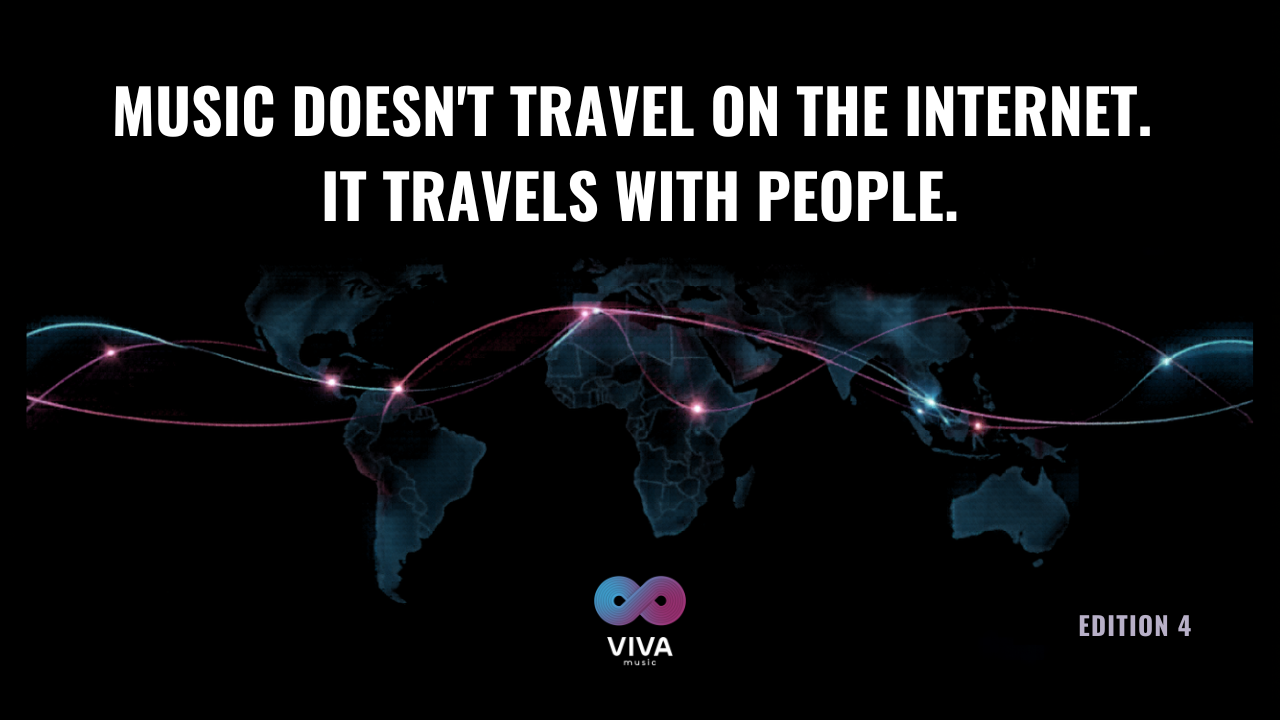
Music Doesn’t Travel on the Internet. It Travels With People.
In 2023 you could not escape Calm Down. It played in a Dubai mall, at a Delhi wedding, in a London Uber, at a Miami pool party. A song by a Nigerian artist, in English and pidgin, became one of the most streamed records on the planet.
The convenient explanation is the algorithm. Spotify pushed it, TikTok looped it, the world caught on.
That explanation is incomplete. It skips the most important step. Before any algorithm recommends a song across borders, somebody has to carry it there. And the people who carry music across borders are almost never marketers. They are migrants.
This edition is about how music actually travels: through diaspora communities, concentrated in a handful of hub cities, moving along corridors that the industry still barely maps.
The Punjabi blueprint
The most instructive case study in modern music is not American or Korean. It is Punjabi.
Punjabi music today is one of the most commercially visible regional sounds in the world. Diljit Dosanjh filled BC Place stadium in Vancouver and made history with the first fully Punjabi set at Coachella. AP Dhillon broke out without a major label, without Bollywood, without Mumbai.
Here is the part most people miss. AP Dhillon did not break out of Punjab. He broke out of Canada. He built his sound and his audience from British Columbia, while Punjabi diaspora hubs like Brampton and Surrey did the amplifying. The music was made in the diaspora, validated by the diaspora, and only then travelled back to India, where it arrived with the glow of international validation.
That is the loop: homeland to diaspora, diaspora transforms it, transformed version returns home bigger than it left. The corridor matters more than either endpoint.
Afrobeats and the London engine
Afrobeats followed the same physics. Long before American playlists noticed, the Lagos to London corridor was doing the work. London's Nigerian and Ghanaian communities built the club nights, the hall parties, the university raves, the promoters. UK media infrastructure, which is dense, English speaking and globally syndicated, amplified what the community had already validated.
By the time Wizkid sold out the O2 three nights running, the industry called it an overnight global breakthrough. It was two decades of diaspora infrastructure finally becoming visible. The US market came after, again through diaspora first: Nigerian communities in Houston, Atlanta and New York were the early adopters who turned community demand into streaming demand.
Amapiano is running the same route right now, from Johannesburg through London and, notably, through Dubai, where the sound moved through DJs and club residencies well before most of the industry caught up. If you watched the right venues, you saw amapiano coming before the data did.
K-pop: the deliberate version
Everything above happened organically. K-pop is what happens when an industry studies the mechanism and builds it on purpose.
Korean labels did not market to "the world." They targeted hub cities with Korean diaspora density and high cultural connectivity: Los Angeles, New York, later Japan, Mexico and the Gulf. KCON was placed deliberately. Fan communities were given tools, content and language to do the carrying themselves. The diaspora and the fandom around it became the distribution network, and the labels resourced that network the way other companies resource retail channels.
The result is one of the most successful planned cultural exports in modern pop culture. Not because the music travelled differently, but because someone finally treated the corridor as infrastructure rather than accident.
Reggaeton and the hub city rule
Latin music's global run offers the final piece. Reggaeton existed for decades across Caribbean and US Latino circuits. Its global run accelerated when it routed through Miami, a city that concentrates Latin American diaspora communities, US media money and international connectivity in one place.
That is what a hub city actually is. Not a big market. A routing node. London does this for African and South Asian music. Toronto does it for Punjabi and Caribbean sounds. Dubai does it for South Asian, Arab and increasingly African music, because its population is overwhelmingly expatriate and those communities bring their music with them, demand it in venues, and broadcast it back home through sheer volume of social connection.
A song breaking in a hub city is not one market won. It is a signal travelling down every corridor that city sits on.
What actually drives all of this
Strip the case studies down and the mechanism is consistent.
Density creates demand. When a community reaches critical mass in a city, it builds its own economy: club nights, wedding circuits, radio shows, festivals, restaurants with sound systems. Music gets commercial infrastructure before any label spends a dollar.
Nostalgia funds it, the second generation transforms it. First generation migrants want the sound of home. Their children remix it with the sound of where they grew up. That fusion is usually the version that travels globally. Drill in Punjabi. Afrobeats with London rap cadences. K-pop built on American pop architecture.
Validation flows backwards. Success in the diaspora reads as international success back home, which multiplies the artist's domestic value. The corridor pays twice.
Physical spaces tend to lead, platforms follow. Again and again, clubs, weddings and community events validated the music before streaming data reflected it. The venues are the early warning system. The playlists are the lagging indicator.
What this means if you market music, or market with music
For labels and artists: map diaspora density before you map market size. The question is not "how big is the UAE music market." It is "how many people in Dubai grew up with this sound, and who programs the rooms they spend money in." Your first international market is almost never a foreign audience. It is your own audience living abroad.
For brands: corridor audiences are bicultural and they can tell instantly when you only speak one of their languages. A campaign aimed at South Asians in the Gulf that just imports a Mumbai campaign will underperform. So will one that treats them as generic Dubai consumers. The brands winning with these audiences match specific artists to specific communities, in the venues and moments where that community already gathers.
For venues and hospitality: your playlist is a market positioning document, whether you treat it that way or not. A room full of diaspora customers being served a generic international playlist is a commercial gap, not a neutral choice. The venues that program for who is actually in the room build loyalty the ones that don't cannot buy back with discounts.
For everyone: watch the hub cities, and watch the physical spaces inside them. By the time a sound shows up in your streaming dashboard, the corridor has usually finished its work.
The industry still treats diaspora audiences as niche markets, a line item after the "real" territories. The case studies say the opposite. Diaspora communities are not a market segment. They are the distribution network. Algorithms scale music. Diaspora moves it first.
The labels, brands and cities that understand this are not predicting where music goes next. They are deciding it.
Kavya Yadav writes The Cultural Economy. Viva Music is a music consultancy and cultural platform working across artists, brands, venues and audiences.
Originally published in The Cultural Economy on LinkedIn on June 12, 2026.