
The Music Industry Is Growing. But Do We Know What a Career in It Looks Like?
For most people, a career in music still means one of a few things. Artist. Composer. Maybe producer.
And if none of those feel realistic, music quickly becomes something you enjoy rather than an industry you consider working in.
That is strange when you look at what the music business has actually become.
The music business is much larger than the recorded music market we usually hear about.
Goldman Sachs estimated the global music market at approximately US$105 billion in 2024, across recorded music, publishing and live music, and expects it to approach US$200 billion by 2035. And even that headline number does not describe the full ecosystem of commercial activity around music, from merchandise and brand partnerships to management, technology, agencies and businesses being built around artists and audiences. Goldman Sachs reports US$105 billion in 2024 and nearly US$200 billion by 2035.
The question is no longer whether music is a serious industry.
The more interesting question is:
Do enough people understand how many different ways there are to build a career inside it?
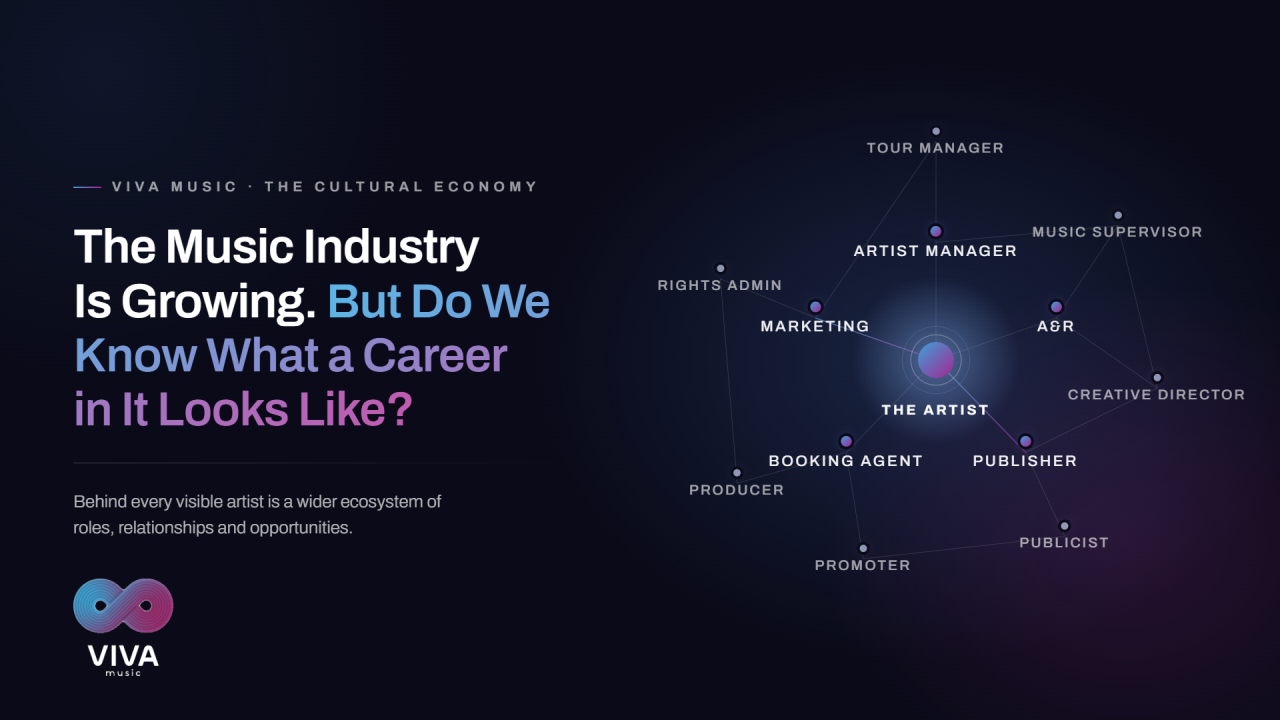
We see the artist. We rarely see the ecosystem.
Take almost any successful record.
We hear the artist. Maybe we know the songwriter or producer.
But look at everything that happens around the music, and another world appears.
The A&R executive helping connect the artist with collaborators.
The publisher managing compositions.
The booking agent negotiating shows.
The tour manager getting a production from one city to another.
The marketing team deciding how a release enters culture.
The creative director shaping a visual world.
The music supervisor placing a song in a film.
The partnership manager connecting an artist with a brand.
The lawyers, rights administrators, promoters, festival programmers, publicists, data analysts, digital strategists, venue teams and countless freelancers surrounding the work.
Perhaps one of the simplest ways to understand the modern music industry is this:
The artist is visible. The ecosystem creates the career.
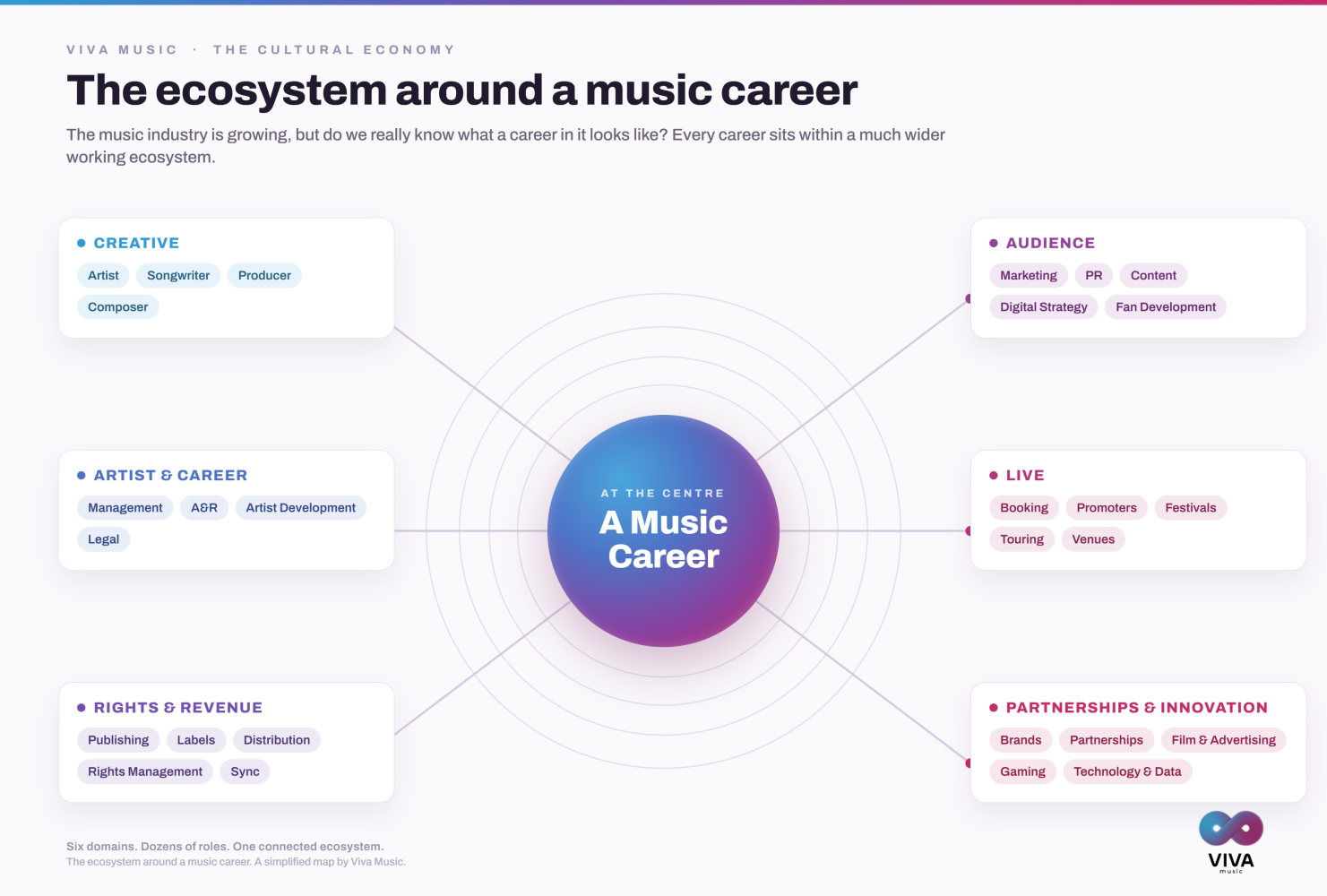
And that ecosystem is becoming larger and more specialised.
The career information gap is real
What interests me most is that the problem is not simply access to music education.
Someone can spend years learning music and still have very little understanding of how a music career actually works.
Learning music and learning how the music industry works are not the same thing.
We teach people how to perform.
Far fewer learn how publishing works, how royalties move, what management actually does, how tours make money, what labels look for, why some songs are valuable for sync, how artists build audiences, how contracts divide rights, or how dozens of non-performing careers fit together.
And increasingly, artists themselves need at least a working understanding of all of these.
Not because every artist should become their own lawyer, marketer and manager.
But because creative careers are now also businesses.
There probably isn't one job waiting for you
There is another uncomfortable reality.
The traditional idea of choosing a profession and performing one clearly defined job fits the music industry badly.
The modern music professional increasingly looks less like a job title and more like a portfolio of capabilities.
A songwriter can also produce.
A producer can develop artists.
A DJ can programme events.
A marketer can specialise in artist strategy.
A composer can work across records, advertising, gaming and film.
An artist manager may move into labels, publishing, touring or partnerships.
Adjacent skills create optionality.
And optionality is extremely valuable in an industry where careers rarely move in straight lines.
But there is a danger in telling everyone to do everything
This is where I think the conversation needs more nuance.
We have spent the last decade celebrating the idea that artists can do everything themselves.
Record at home.
Upload directly.
Market through social media.
Build an audience.
Sell tickets.
Own the masters.
Manage the community.
And technologically, much of this is now possible.
Spotify says independent artists and labels accounted for roughly half of the royalties it paid to the music industry in 2025. More than 13,800 artists generated at least US$100,000 in royalties from Spotify alone that year, while more than 1,500 generated over US$1 million.
It is genuine democratisation.
But access to distribution should not be confused with access to success.
The answer cannot be that an 18-year-old musician now needs to become a world-class songwriter, producer, content creator, performance marketer, graphic designer, accountant and rights expert.
That is not empowerment. Eventually, it becomes a distraction.
The strongest careers I see are increasingly built around a T-shaped model:
Deep enough in one discipline to become genuinely valuable.
Broad enough across the surrounding business to understand where that value fits.
An artist should understand marketing without spending every day inside an advertising dashboard.
A manager should understand publishing without pretending to be a copyright lawyer.
A songwriter should understand audience behaviour without allowing an algorithm to dictate what they write.
Specialisation still matters.
What has changed is that specialisation without context is becoming dangerous.
Your talent is only one layer of your career
I increasingly think sustainable careers in music are built on four layers.
1. Craft
You still need to be exceptionally good at something.
Technology has lowered the barrier to making music. It has not lowered the value of taste, originality or excellence.
2. Commercial literacy
You need to understand how value is created around the work.
Masters. Composition. Publishing. Live. Sync. Brand partnerships. Merchandising. Fan relationships.
The music may be emotional. The infrastructure around it is economic.
3. Relationships
Music remains an unusually relationship-driven business.
Songs are written with people. Artists are discovered by people. Shows are booked by people. Partnerships happen because somebody trusts somebody else.
4. Adaptability
The role you enter the industry through may not be the role that eventually defines your career.
And that is not failure.
Some of the most interesting people in music move between creative, commercial and cultural roles over decades.
The objective should not always be to predict your final job when you are just starting out.
It should be to understand the ecosystem well enough to find where your abilities create value.
Then AI enters the room
Now add AI.
Production tools are becoming easier.
Content creation is becoming faster.
Data analysis is becoming cheaper.
Some administrative work will undoubtedly become automated.
This does not make music careers irrelevant.
It changes which abilities become scarce.
When execution becomes easier, judgment becomes more valuable.
Taste.
Curation.
Cultural understanding.
Storytelling.
Relationships.
Community.
Live experience.
Creative direction.
Knowing why something matters rather than simply knowing how to produce it.
At the same time, rights literacy becomes even more important. CISAC reported that global collections for music creators reached €12.59 billion in 2024, up 7.2%. A CISAC-commissioned study has also warned that, under current conditions, generative AI could put 24% of music creators' revenues at risk in 2028.
The future music professional therefore needs to understand technology without becoming subordinate to it.
And this conversation feels particularly relevant in this region
MENA recorded music revenues grew 15.2% in 2025, with streaming accounting for 97.5% of the market. IFPI describes MENA as the joint second-fastest-growing region for recorded music in 2025.
Meanwhile, the UAE has started building something equally important: rights infrastructure.
In 2025, the UAE Ministry of Economy granted collective music management licences designed to strengthen the administration, collection and distribution of music rights.
These might sound like technical developments.
They are not.
Markets become music industries when the infrastructure around creativity develops alongside the creativity itself.
Artists matter.
But so do managers, publishers, venues, promoters, educators, labels, rights organisations, agencies, studios, festivals, brands, investors, technology companies and the people who connect all of them.
That is how scenes become ecosystems.
Maybe we need to change the first question
When a young person says they love music, we often ask:
"Do you want to become an artist?"
Perhaps that is the wrong starting point.
Maybe we should ask:
What part of music fascinates you?
Do you love discovering artists?
Building things?
Writing?
Understanding audiences?
Organising experiences?
Technology?
Business?
Visual culture?
Performance?
Sound?
Storytelling?
Negotiation?
Because somewhere inside the music ecosystem, there may be a career built around exactly that ability.
This is one of the reasons Viva Music is building Future in Music, an ongoing platform for people aspiring to enter the music ecosystem and looking for guidance on where their skills, interests and ambitions fit within it.
Not to tell people that everyone should work in music.
And certainly not to sell the fantasy that becoming an artist is easy.
The opposite.
I want to make the industry more visible.
To show how the pieces actually connect, where careers exist beyond the stage, what changes when creativity becomes a business, and what someone entering music today should understand about the industry they are stepping into.
Because perhaps the biggest gap in music right now is not talent.
It is career literacy.
And in an industry changing this quickly, knowing what is possible may be the first competitive advantage.
Kavya Yadav writes The Cultural Economy and leads Viva Music, a music consultancy and cultural platform working across artist strategy, live music, brand partnerships, cultural programming and the development of stronger music ecosystems.
Originally published in The Cultural Economy on LinkedIn on July 26, 2026.