

When Music Has a Price, a Market Gains Value
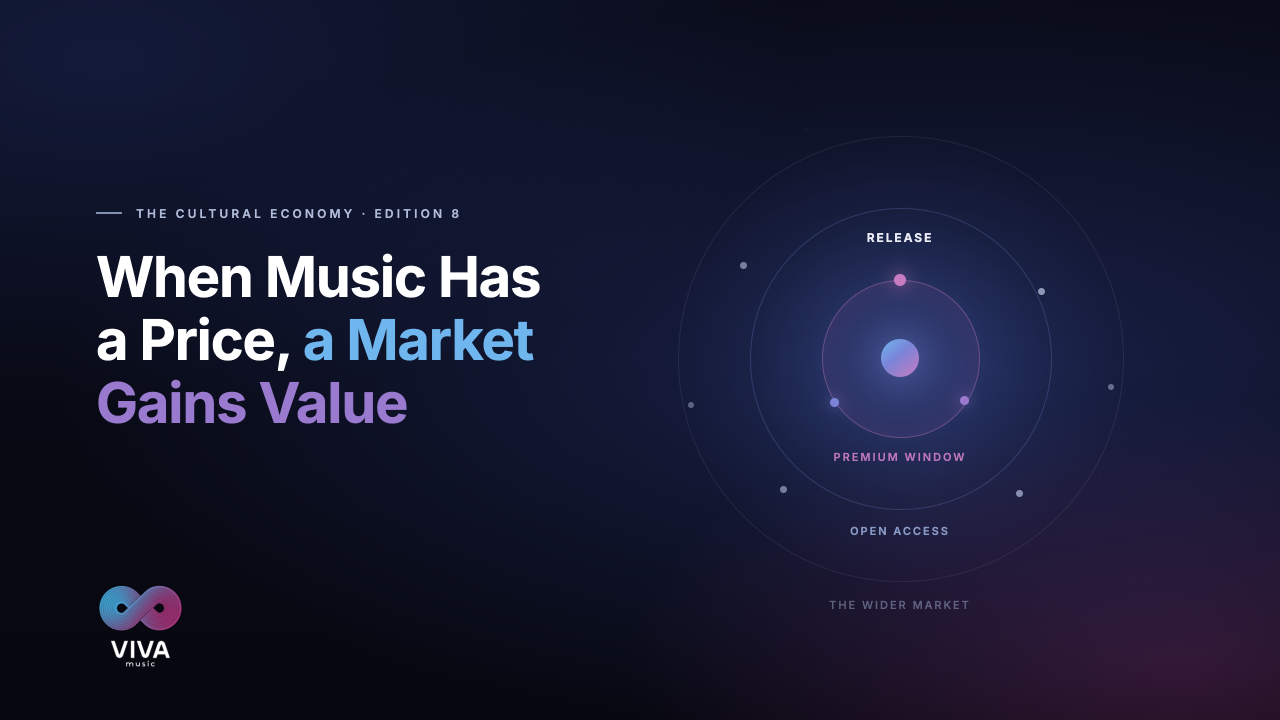
Universal Music’s 72-hour premium window in India raises a larger question about the cultural economy and whether a music market can thrive if listeners are never given a reason to pay for music.
For more than a decade, the music-streaming revolution has been presented as a victory of access. Almost any song, in almost any language, can now travel from a recording studio to a smartphone within seconds. That accessibility has expanded audiences, accelerated cultural exchange and given regional artists a route to global listeners.
But access alone does not create a sustainable music economy.
A country can generate billions of streams, dominate social-media trends and produce internationally successful artists while still capturing remarkably little economic value from its music. Reach and market strength are not the same thing. The first measures how widely culture travels; the second measures whether the people creating, developing and distributing that culture can build lasting businesses around it.
Universal Music Group’s latest move in India brings this tension into focus. Beginning at the end of August 2026, UMG’s major new domestic and international releases will initially be available only to paying streaming subscribers. After a 72-hour window, the music will become available on ad-supported services as well.
The company describes the strategy as part of an effort to build a “healthier” music market, one in which fans retain broad access but premium subscribers receive something meaningfully valuable in return. The approach has already been tested in China, where greater use of paid-access models coincided with the country’s rise to become the world’s fourth-largest recorded-music market in 2025. China’s recorded-music revenue grew 20.1% that year, the fastest rate among the world’s twenty largest markets. (Music Business Worldwide, IFPI)
The lesson is not that all music should disappear behind a paywall. It is that a market cannot indefinitely offer its most desirable product, at its most valuable moment, with no compelling reason to pay.
India’s paradox: extraordinary attention, limited conversion
India illustrates the difference between a large listening population and a high-value music market.
Estimates suggest that the country had roughly 14.4 million paid music subscriptions in 2025, following the addition of nearly four million subscriptions during the year. Yet India’s total music-streaming audience is estimated at between 175 million and 220 million users. Even allowing for differences between subscriptions, users and bundled accounts, the gap is enormous. (Music Business Worldwide)
India does not have a music-consumption problem. It has a value-conversion problem.
Affordable mobile data and free streaming helped produce one of the world’s most active listening cultures. They expanded access across income groups, languages and regions and created powerful discovery channels for Punjabi, Tamil, Telugu, Hindi and other repertoires. That foundation should not be dismissed: free access has real cultural and commercial value.
However, when nearly every important benefit is available without payment, the free tier stops functioning as an entry point and becomes the final destination. Consumers learn that music is abundant but not necessarily worth purchasing. Platforms compete for attention while advertising income and low-priced subscriptions are divided across an immense volume of streams. Artists may become visible without becoming economically secure.
The result is a market rich in cultural demand but comparatively poor in investable revenue.
What a paid subscriber changes
A paid subscription is more than a monthly transaction. It creates a recurring pool of predictable revenue.
Predictability matters because music is financed before its success is known. Recordings, videos, marketing campaigns, touring teams, producers, songwriters, managers and audience-development programmes all require investment. When future revenue is highly uncertain, businesses naturally concentrate resources on established stars and immediately commercial genres. When dependable income grows, the market gains greater capacity to take risks on new artists, regional scenes and specialised repertoire.
Subscription income also reduces complete dependence on advertising. Advertising can fund access, but its value fluctuates with the economy, the listener’s location and the amount advertisers are willing to pay. A listener may spend hours with a service while generating only limited advertising revenue. A paid account establishes a clearer economic relationship between the consumer, the platform and the music being consumed.
Globally, that relationship has become the foundation of the recorded-music recovery. In 2025, paid subscription-streaming revenue grew 8.8% and represented 52.4% of all recorded-music revenue. The number of users of paid subscription accounts reached 837 million. Total recorded-music revenue rose to $31.7 billion, the industry’s eleventh consecutive year of growth. (IFPI Global Music Report 2026)
These figures do not prove that every subscription dollar reaches artists fairly. Royalty structures, contractual terms, platform power and the allocation of streaming revenue remain legitimate subjects of debate. But there must first be sufficient value in the system to distribute. An argument about dividing the pie cannot substitute for the work of growing it.
The value of the first 72 hours
UMG’s strategy recognises that music does not have equal commercial value at every point in its life cycle.
The first hours after a major release carry urgency. Fans want to participate in the cultural moment, share reactions and hear the work before the conversation moves on. In cinema, books, gaming and live entertainment, early access routinely commands a premium. Recorded music has often abandoned that principle by releasing the same product, at the same moment, to free and paying audiences.
A short premium window changes the proposition without permanently excluding free listeners. Paying subscribers receive immediacy; ad-supported users receive the same music three days later. The product remains widely accessible, but time becomes part of its value.
This is a modest form of differentiation, yet symbolically it is important. It tells consumers that payment unlocks something more than the removal of advertisements. It also allows the industry to test listeners’ willingness to pay without constructing a permanent cultural barrier.
The approach carries risks. If premium windows are applied too broadly, priced poorly or introduced without consumer education, listeners may turn to piracy, unauthorised uploads or competing releases. IFPI’s global consumer research found that 29% of respondents had used illegal or unlicensed methods to listen to or obtain music. (IFPI, Engaging with Music 2023)
A paywall is therefore not a complete market strategy. It must be supported by affordable pricing, convenient payment methods, reliable licensing and a premium experience that feels genuinely better.
Free access should be a bridge, not the whole city
The strongest streaming market is not necessarily one that eliminates free listening. Free tiers perform essential functions: they introduce new users to legal services, enable discovery and keep licensed platforms competitive with piracy. In price-sensitive economies, removing them entirely could narrow participation and damage emerging artists who depend on wide circulation.
The more useful objective is a balanced market architecture:
- Free access should make legal listening easy and attractive.
- Paid access should deliver recognisable additional value.
- Pricing should reflect local purchasing power.
- Entry-level, student, family, mobile-only and short-duration plans should lower the barrier to payment.
- Telecom, banking and retail bundles should make subscriptions simple to acquire, but still preserve a visible economic value for music.
- Premium benefits can include early releases, higher-quality audio, offline listening, exclusive sessions, ticket priority, artist communities and verified superfan experiences.
This is how consumers move from casual access to active participation in the cultural economy.
The language used around payment matters too. The industry should not shame audiences who use free services. Many listeners have grown up in an environment where music appears automatically inside video, social and telecommunications products. Paying for recordings may not yet feel like a normal standalone behaviour.
The industry’s task is to demonstrate what payment makes possible: more recordings, stronger regional labels, better artist development, professional employment and a greater chance that local talent can build sustainable careers without leaving its home market.
A valuable market exports more than songs
Strengthening the recorded-music economy has effects beyond streaming revenue.
A market with reliable income can support managers, producers, publishers, venues, marketing agencies, technicians, lawyers, data analysts and music-technology companies. It can finance collaborations, showcase festivals and international campaigns. It gives artists greater leverage when negotiating with brands and global platforms. It also gives governments and investors clearer evidence that music is an economic sector, not simply a source of entertainment or cultural prestige.
This is particularly significant for countries with young populations, widespread smartphone use and deep linguistic diversity. Their opportunity is not merely to consume global catalogues more efficiently. It is to build intellectual property at home, retain more of its value and export locally rooted culture on equitable commercial terms.
China’s experience is encouraging, but it should not be treated as a simple formula. Its growth reflects several forces, including subscription adoption, platform development, licensing, local repertoire investment and superfan products. UMG’s 72-hour window did not single-handedly create that market, and a similar policy will not transform India by itself.
It is better understood as a signal: the next phase of streaming growth must focus on value, not only volume.
For years, the digital music business asked how many people it could reach. The more important question now is how that reach can sustain the people and institutions responsible for the music.
A healthy cultural economy should preserve discovery and broad participation. But it must also establish that music has value—and give listeners practical, affordable and meaningful ways to pay for it.
Music can be universally accessible without being economically invisible. The future belongs to markets capable of achieving both.
Kavya Yadav writes The Cultural Economy and leads Viva Music, a music consultancy and cultural platform working across artist strategy, live music, brand partnerships, cultural programming and the development of stronger music ecosystems.
Originally published in The Cultural Economy on LinkedIn on August 1, 2026.